The useful part of an agentic system is not the number of agents. It is whether the system can accept a real objective, send the work to the right capability, preserve context, check the result, and stop for human judgment when the stakes change.
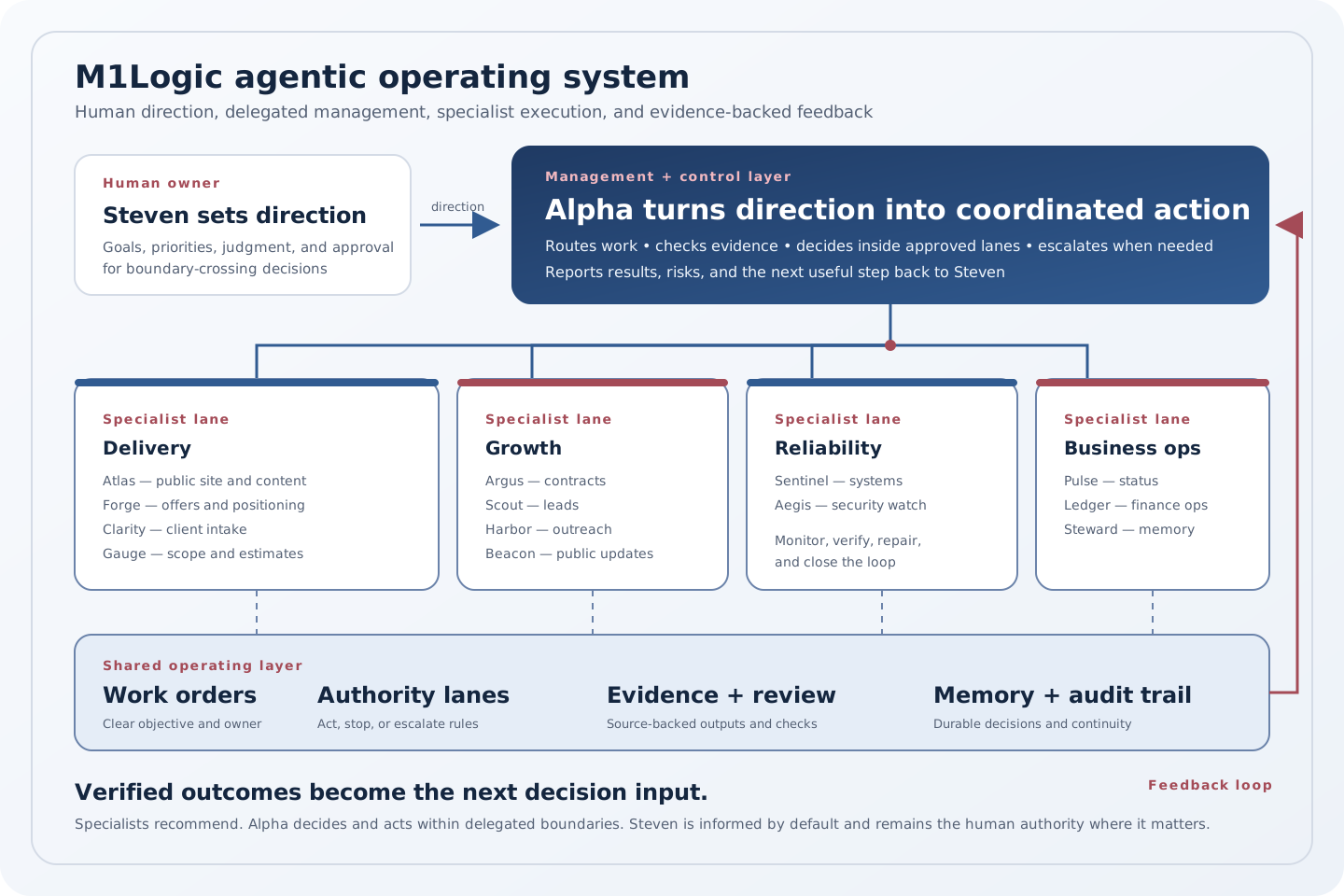
That is the model we have been building at M1Logic. A management agent called Alpha sits between owner direction and a group of specialist agents. Each specialist has a defined job. Shared work orders, authority rules, evidence checks, and durable records keep the pieces connected.
The result is less like a chat room full of bots and more like a lightweight operating team: clear roles, clear handoffs, and a visible chain from request to result.
The architecture
The system uses a hub-and-spoke design. Steven sets goals and boundaries. Alpha translates that direction into assignments and operating decisions. Specialist lanes do focused work, while a shared operating layer makes that work reviewable and repeatable.
How we built it
1. We started with jobs, not personalities.
Every specialist exists because there is a recurring category of work: reviewing intake, shaping an offer, estimating scope, maintaining the public site, researching opportunities, monitoring systems, watching security advisories, tracking operating status, or preserving business memory.
The names make the roster easier to use, but the real design is the responsibility behind each name. A specialist needs a defined input, a useful output, and a clear handoff. Without those three things, an agent is only another place for work to get lost.
2. We put one management layer in the middle.
Alpha is the owner-facing interface and the accountable coordinator for routine operations. Instead of asking Steven to manage every specialist separately, Alpha receives the objective, chooses the right lane, reviews the result, and decides the next step inside delegated boundaries.
This has been one of the most important design choices. Specialist agents can stay narrow. The management layer carries cross-functional context and prevents a good local answer from becoming a poor business decision.
3. We made authority explicit.
Autonomy is useful only when the system knows where it ends. Routine, reversible, public-safe work can move without repeated permission. Spending, binding commitments, sensitive disclosure, destructive actions, and high-risk production changes still stop for human review.
This turns “human in the loop” from a vague promise into an operating rule. The human is not asked to approve every harmless step, and the agents are not allowed to quietly expand their own authority.
4. We made artifacts part of the system.
Chats are temporary. Operations need durable state. Work orders define the objective and owner. Reports capture evidence. Decision logs record why an action was reasonable. Memory notes preserve lessons across sessions. Verification closes the loop after a change.
Those artifacts are not administrative decoration. They are the connective tissue that lets the system resume, audit itself, and avoid making the same decision from scratch every time.
How it is going
The early direction is positive. The biggest improvement is not that more tasks can run at once. It is that work has a clearer path from signal to owner to evidence-backed closeout.
Follow-through is stronger.
Site updates, operating reviews, maintenance work, product support, and public communications are less likely to remain disconnected tasks. The system carries the handoff and records the result.
Specialization improves the review.
A site change is viewed as a public-content problem. An estimate is viewed as scope and risk. A maintenance item is viewed as detection, execution, rollback, and proof. The questions become more specific.
Routine work moves faster.
Clear operating lanes reduce the need to re-litigate safe, reversible decisions. That leaves human attention for commitments, exceptions, strategy, and genuinely consequential choices.
The system is easier to inspect.
Work orders, reports, checks, and decision notes create a trail. When something needs correction, we can see where the workflow broke instead of treating the entire agent concept as a black box.
There are concrete signs that the model is useful: M1Logic has kept a growing public product and service portfolio moving, improved its site and intake paths, maintained operating visibility, and handled routine reliability work with documented before-and-after checks.
We are also careful about what that proves. Activity is not revenue. A completed internal workflow is not automatically customer value. The system is helping us execute more consistently; the next level of proof is showing that this consistency leads to better customer outcomes, stronger distribution, and repeatable business results.
What we have learned
- Coordination matters more than agent count. Adding a specialist helps only when its responsibility and handoff are clearer than the process it replaces.
- Delegation needs stop conditions. Useful autonomy includes knowing when to act, when to verify, and when to ask a human.
- Memory should live in artifacts. Durable notes and decisions are more reliable than expecting a model to carry every detail indefinitely.
- Verification belongs in the workflow. “Done” means the change was checked and its effect is understood, not merely that an agent produced an answer.
- Business evidence stays the real scoreboard. Agent output is leverage. Customer value, repeat use, reliability, and revenue are the outcomes that matter.
What comes next
Our next step is not to add agents for the sake of it. It is to improve the measurements around the system: cycle time, rework, successful handoffs, maintenance closeout, customer response, conversion, and repeat use. That will help us see which parts of the architecture create real leverage and which parts are merely busy.
For clients, the broader lesson is practical. An agentic system does not have to replace a team or take over every decision. It can begin with one costly workflow, a narrow set of tools, a clear owner, and a human approval boundary. That is often enough to turn scattered AI experiments into a system people can actually trust and use.
Have a workflow that could benefit from agent support?
M1Logic can help map the work, choose the right automation boundary, and build a system that stays understandable after launch.